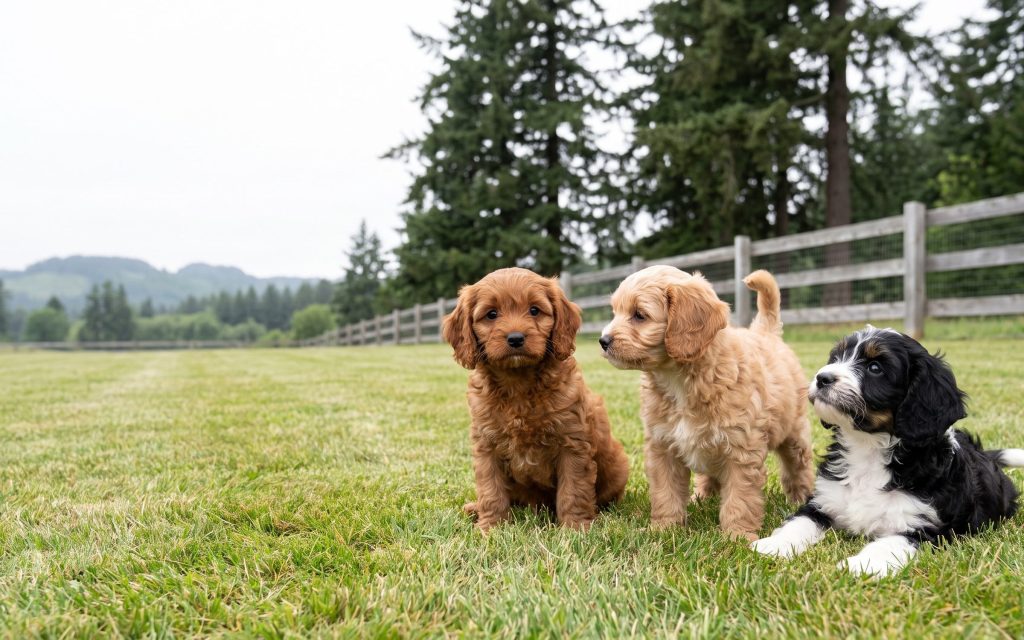
Toy, Teacup and Standard: What Puppy Size Labels Really Mean

Toy, teacup, mini, standard. The size words attached to small-breed puppies are marketing shorthand, not official categories, and knowing what they actually mean protects you and the puppy.
There is no universal, regulated definition of a teacup dog. These terms describe a rough adult size, and different breeders use them differently. What matters is the honest expected adult weight of the individual puppy, not the label on the listing.
What the words usually mean
- Toy: the smaller end of a small breed, often driven by a Toy Poodle parent in our crosses.
- Teacup: an unofficial term for the very smallest individuals, typically well under the breed’s normal range.
- Mini or miniature: a middle size, common for Cavapoos and some Dachshunds.
- Standard: the full, typical adult size for the breed.
Deliberately breeding for the extreme smallest size can come with real health trade-offs, including fragile bones, dental crowding and blood-sugar issues. We do not chase teacup extremes. We aim for healthy, sound small dogs and give you an honest expected adult weight instead of a dramatic label.
How to read a size estimate
A responsible estimate is a range, not a promise. It is based on the parents, the puppy’s current weight and growth, and breed experience. Ask for the expected adult weight in pounds, and remember that a puppy’s current weight plus its parents tells you far more than any single word. We have set out the real ranges for two of our crosses in how big Maltipoos get and how big Cavapoos get.
| Question to ask | Why it matters |
|---|---|
| Expected adult weight range? | The only number that actually plans your life |
| How big are the parents? | The best single predictor of adult size |
| Any health trade-offs at this size? | Honest breeders will tell you |
Our approach
Every Everpine listing shows an honest expected adult size drawn from the puppy’s own records, not a breed encyclopedia. If a puppy will be very small, we say so plainly, along with what that means for care.
- Size words are not official. Ask for an expected adult weight range in pounds.
- Teacup is a caution flag. The extreme smallest sizes can carry health trade-offs.
- Parents predict size. Their weight tells you more than any label.
Size estimates are projections, not guarantees. Your veterinarian can advise on healthy growth and weight for your individual puppy.
Use size labels to ask better questions
Rather than choosing only by the words “teacup,” “toy” or “mini,” look for the puppy’s current age and weight and a carefully qualified adult-size estimate. Ask how the estimate was reached and consider the parents’ sizes where that information is available. For a home with stairs, young children or travel-carrier restrictions, what matters is safe handling and the likely size range—not a marketing category.
You can compare puppy-specific estimates on Everpine’s available puppies page and ask follow-up questions about the individual dog.
More from the Everpine Journal
- Breeds
Dachshund Colors and Coat Types, Explained
5 min read - Breeds
How Big Do Cavapoos Get? Full-Grown Size Explained
4 min read - Breeds
How Big Do Maltipoos Get? Full-Grown Size Explained
4 min read